
How to Build Buyer Personas for a Service Business (Start With a Super Avatar)
 By Michael Preston · · 7 min read
- Start with one super avatar: the single best type of customer you would clone if you could.
- Split that avatar into 2 or 3 buyer personas by what triggers the call and what objection holds them back.
- Use each persona to change one thing: the ad message, the landing page or the offer.
Buyer personas are short profiles of the people you want to reach. For a service business, the fastest way to build useful ones is to start with one super avatar, your single best type of customer, and then split it into two or three personas. If you are not sure where your marketing is losing people today, the free funnel audit is a quick place to start. The tools page shows the CRM and forms I use to collect what customers say.
Find Out Where Your Marketing Is Losing Money
12 quick questions. The same 5-Point Funnel Audit I run before I start work on a client's ad account.
This is the framework I use: super avatar first, then buyer personas, then the offer stack. Below is the method step by step, with a worksheet you can copy.
Why most buyer personas never get used
Most personas are too long and too made up. They list an age, a job title, a favorite coffee and a stock photo. Then they sit in a folder.
A persona is only useful if it changes a decision. Which ad do we run? What goes at the top of the landing page? What do we include in the offer? If a persona cannot answer one of those questions, it is decoration.
The other problem is guessing. Personas built in a meeting room tend to describe the customer you wish you had. Personas built from real calls, reviews and questions describe the customer you can actually win.
Start with one super avatar
What a super avatar is
A super avatar is a profile of your best customer. Not your average customer, your best one. The job was a good fit, they paid on time, they were easy to work with and they sent friends your way.
Pick one real customer, or a small group who are very alike, and describe them in detail. One clear picture beats five blurry ones. Everything else in this method builds on it.
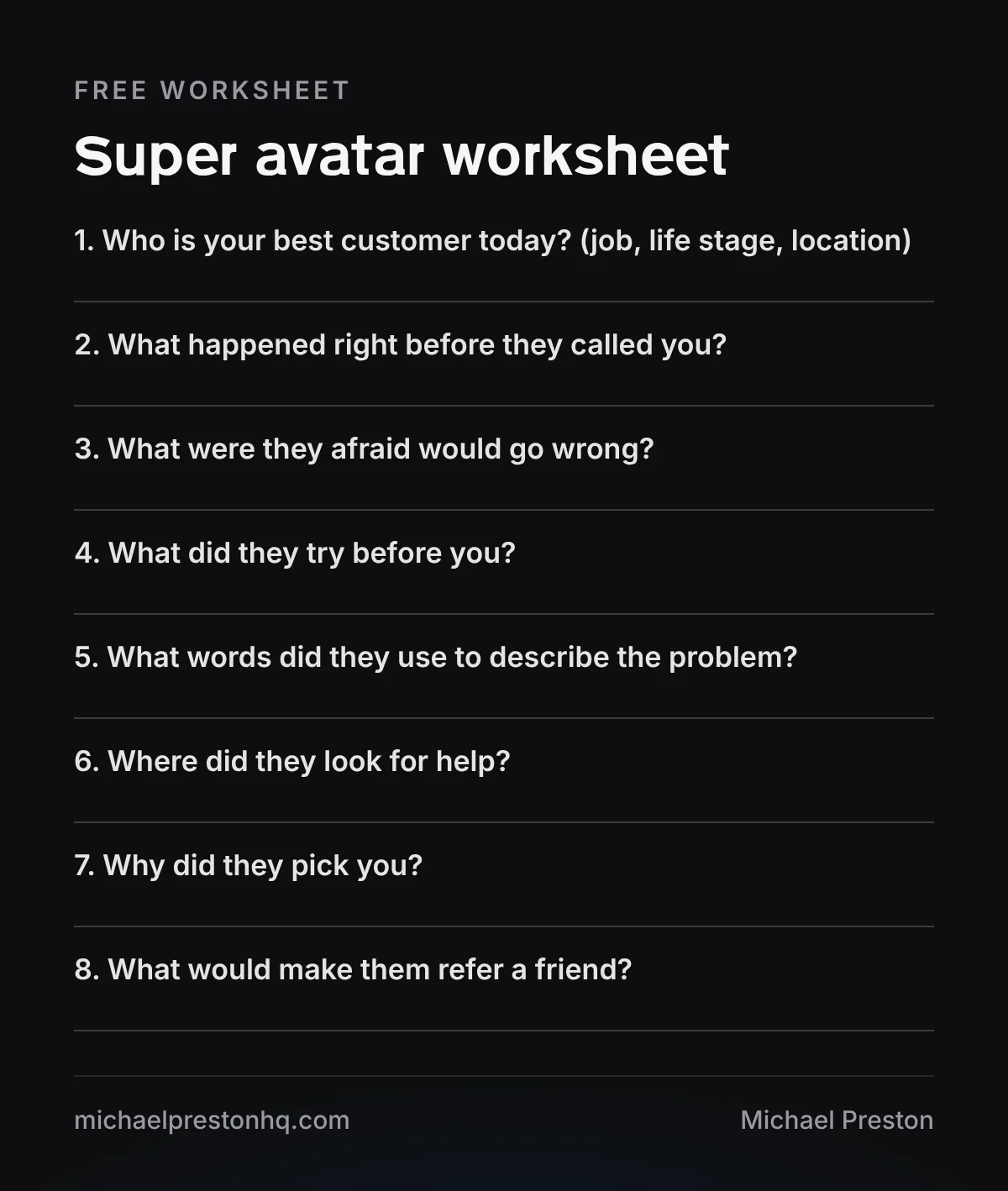
Questions to answer about your best customer
Answer these in their words where you can. Reviews and call recordings are great sources.
- Who are they? Life stage, type of home or business, and where they are.
- What happened right before they called you?
- What were they afraid would go wrong?
- What did they try before you?
- What words did they use to describe the problem?
- Where did they look for help?
- Why did they pick you over the others?
- What would make them refer a friend?
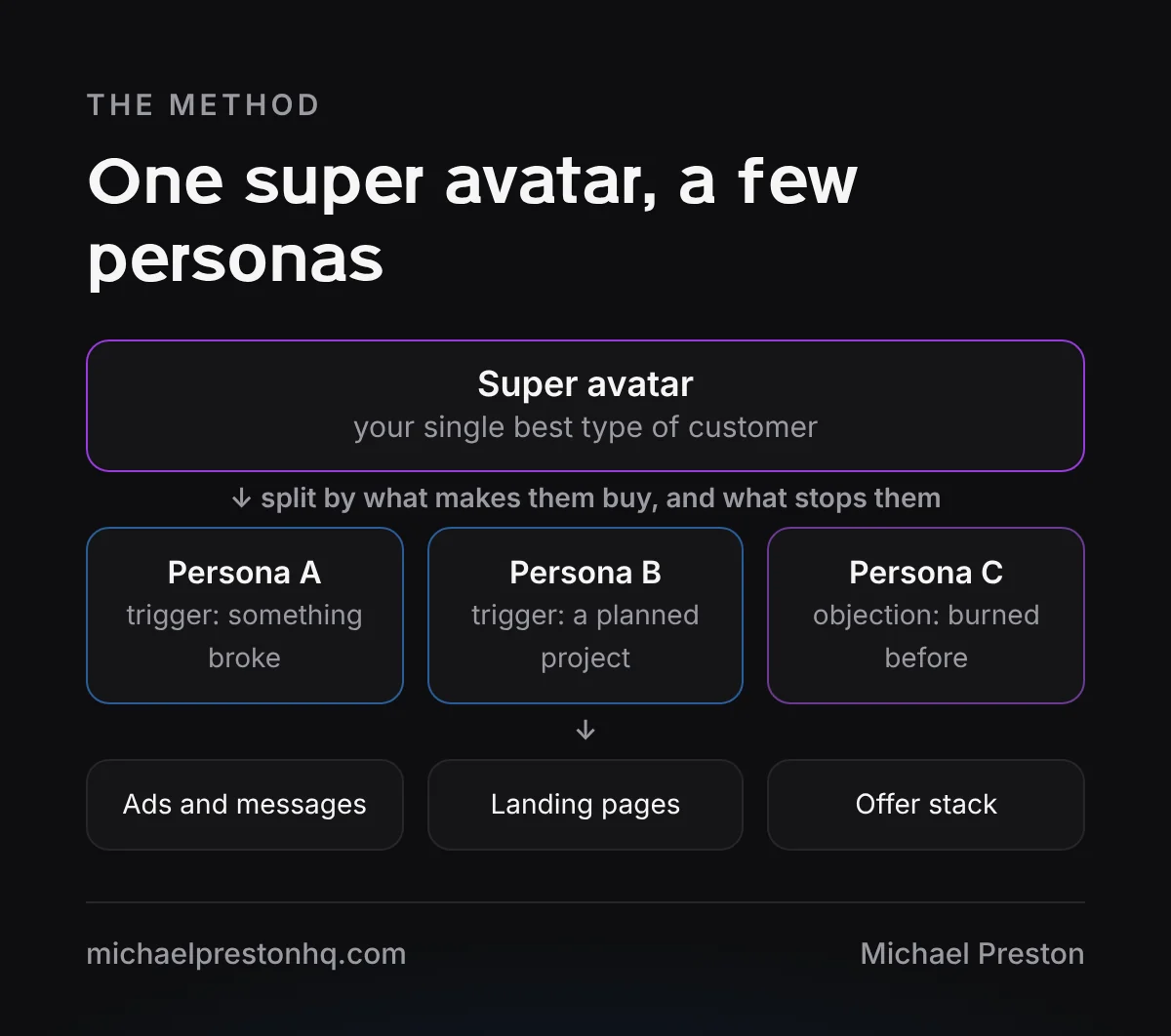
Split it into buyer personas
Your best customers do not all call for the same reason. Splitting the avatar shows you where the message needs to change. There are two splits that work well for service businesses.
By trigger
A trigger is the event that makes someone pick up the phone. For a roofer it might be a leak after a storm, a home sale inspection, or a planned remodel. Same service, three very different moments.
Each trigger has its own urgency and its own questions. The storm leak needs someone fast. The planned remodel wants options and a clear process. Those should not get the same ad.
By objection
An objection is the thing that almost stops someone from buying. “I can do this myself.” “The last company I hired disappeared.” “I need my spouse to agree.” List the top objections you hear, and see which ones belong to which type of customer.
An objection persona tells you what proof to show and what to say first. Someone who got burned before needs to see a clear process and real reviews before anything else.
Buyer persona example
Here is a short example for a made-up business. Notice how little it includes. Every line should change something you write or offer.
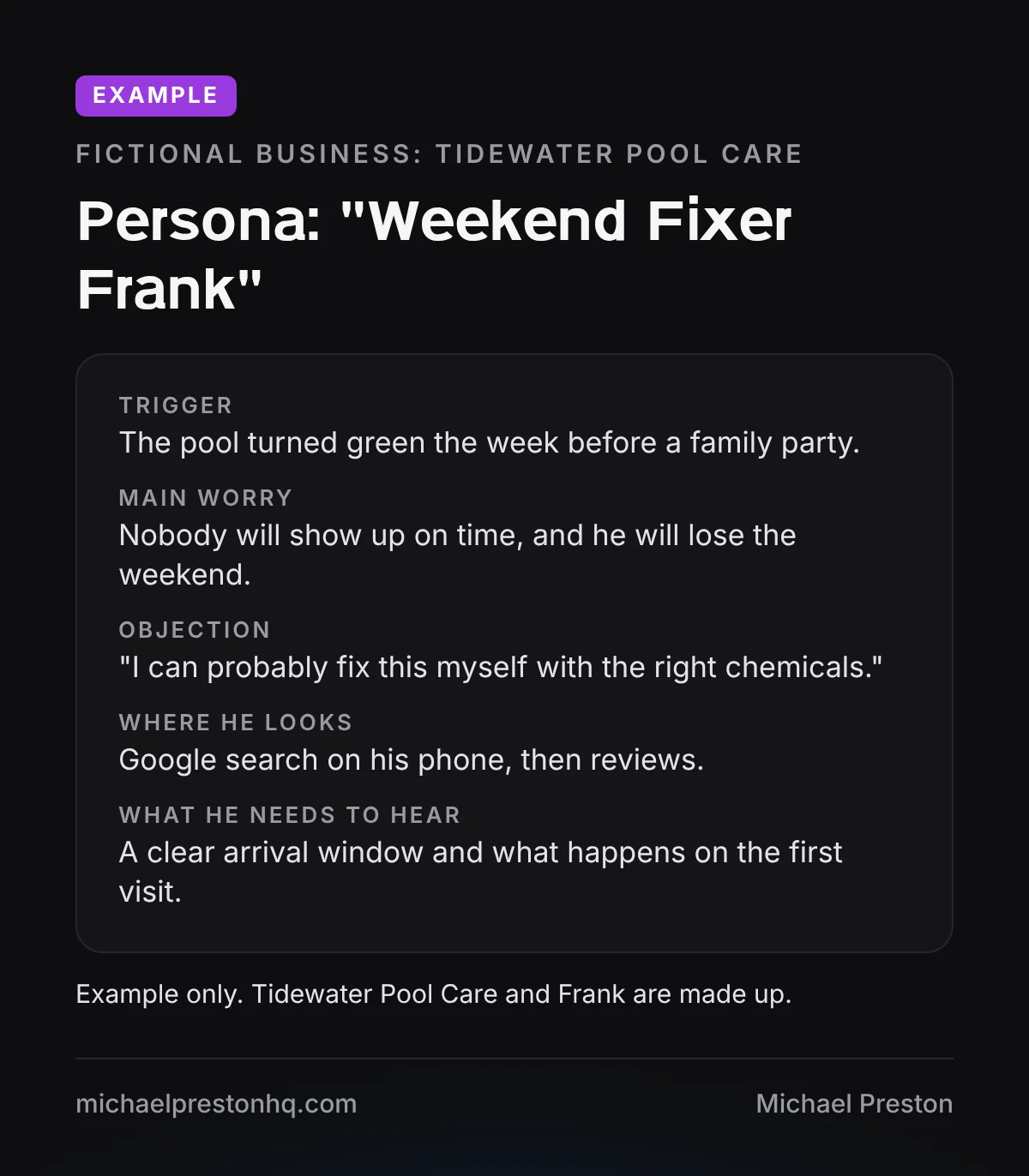
For Tidewater Pool Care (a made-up business), "Weekend Fixer Frank" calls when the pool turns green right before an event. The ad leads with speed and a clear arrival window. The landing page answers "Can I just fix this myself?" in the first few lines.
How personas change ads, landing pages and offer
Once you have two or three personas, use them in three places:
- Ads. Write one ad angle per persona. Use the trigger and the words customers used. If you are deciding where to run them, see Google Ads vs Facebook Ads.
- Landing pages. Put the answer to the main objection near the top. Show the proof that persona needs.
- Offer. Shape what you include around what each persona is afraid of. The offer stack guide covers this step.
Start with one change, not ten. Rewrite the top of one landing page for your biggest persona, then watch whether calls and form fills change.
Using personas with a team
Personas work best when everyone who talks to customers knows them. Share a one page version with whoever answers the phone, writes your ads and does estimates. Ask them what they hear that the personas miss.
Review them a couple of times a year. Services change, markets change and new objections show up. A quick update keeps them useful.
Mistakes to avoid
- Too many personas. If you have six, nobody remembers any of them. Two or three is plenty for most service businesses.
- Demographics only. Age and income rarely change what you write. Triggers and objections do.
- Made up details. If a line did not come from a real customer, a review or your team, cut it.
- No owner. Someone should be in charge of keeping the personas current and making sure they get used.
- Building them once and forgetting them. Treat them as working notes, not a finished document.
A good test: hand a persona to someone who writes your ads and ask what they would change. If they can name something right away, the persona is doing its job. If they shrug, it needs sharper triggers and objections.
How to get real answers from customers
The best answers come from short conversations with real customers. Pick three or four people who fit your super avatar. Tell them you are trying to improve how you explain your service, and ask for ten minutes.
Ask the worksheet questions and then stay quiet. Write down the exact words they use, especially about the problem and the worry. Those words are often better ad copy than anything you would write yourself.
If calls feel like too much, start with your reviews and your inbox. Look for repeated phrases. Ask whoever answers your phone which questions come up every week. You will usually find the main triggers and objections in an afternoon.
Keep everything in one shared document. Add new phrases as you hear them, and note the date, so you can see how your customers change over time.
When you update a persona, tell the people who use it. A quick note to whoever writes your ads, answers your phone or builds your pages keeps everyone working from the same picture of the customer.
Free worksheet
Copy the questions below, or download the printable version. Fill it out for one real customer first, then split it into personas.
Want to know more about how I work? Read my background. If you run a group or event, my speaking page lists the topics I cover.