
Google Local Services Ads vs Google Ads: Which Fits Your Service Business?
 By Michael Preston · · 8 min read
- Local Services Ads charge per lead and show your Google listing. Search Ads charge per click and send people to your page.
- LSA has less control and requires screening, but it can be simple for eligible home and local services.
- Many service businesses run both: LSA for calls, Search Ads for services and areas LSA does not cover well.
Google Local Services Ads (LSA) charge you per lead and show your business listing with a screening badge. Google Search Ads charge you per click and send people to your own landing page. Before you pick, run the free funnel audit to check whether your phone handling and follow-up are ready, since both depend on them. The tools I use page lists the call tracking and CRM setup I use to compare them.
Find Out Where Your Marketing Is Losing Money
12 quick questions. The same 5-Point Funnel Audit I run before I start work on a client's ad account.
Google changes LSA rules often, by category and by location. Treat this post as a plain guide, and check Google’s help pages for your category before you start.
What Local Services Ads are (and Google Guaranteed)
Local Services Ads are a separate ad type for local service businesses like plumbers, electricians, HVAC companies, cleaners and many others. When they show, they usually sit at the top of the results, above the regular search ads.
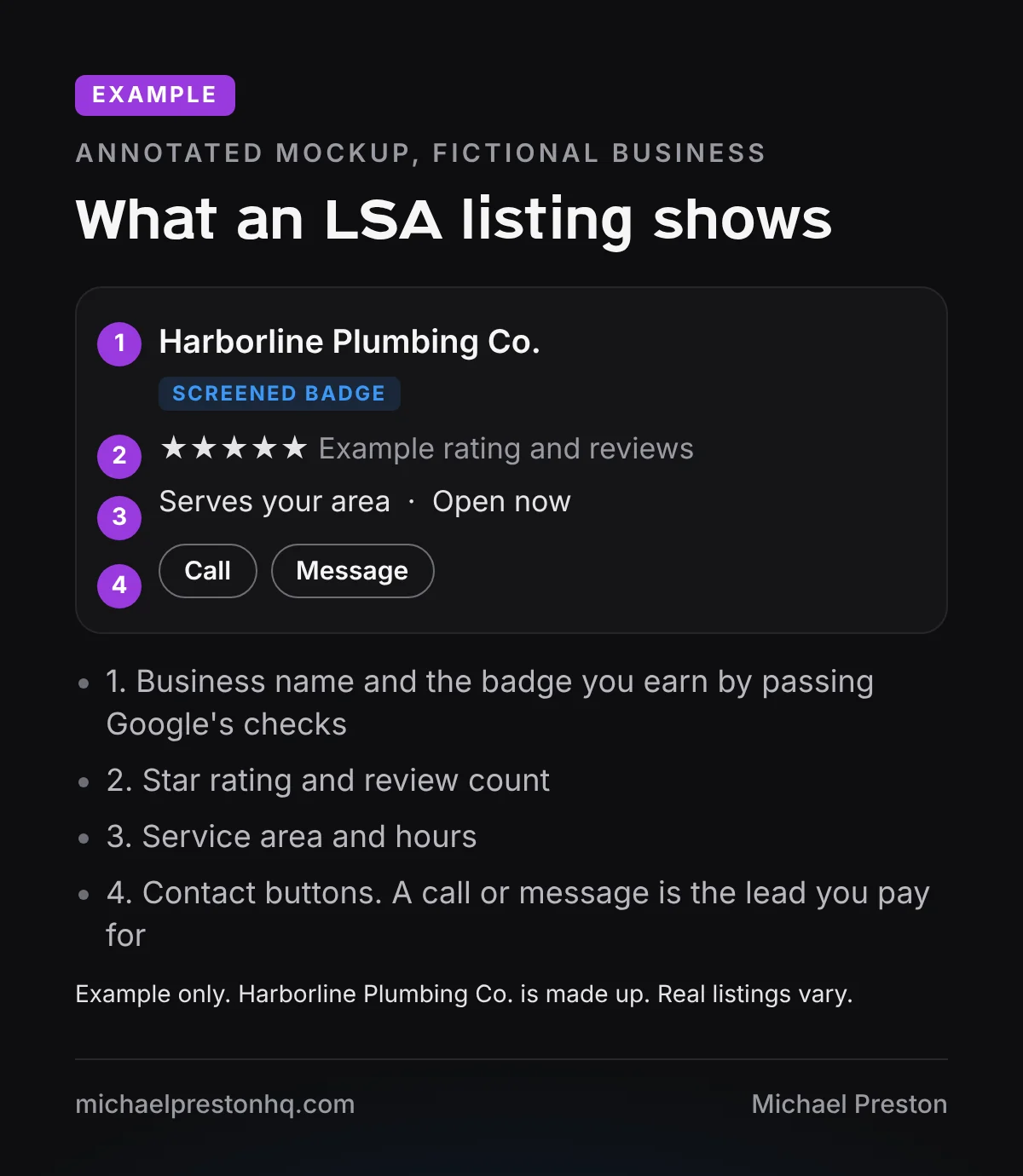
To run them, your business goes through Google’s screening. Depending on the category, that can include license, insurance and background checks. Businesses that pass get a badge, such as Google Guaranteed or Google Screened, on their listing.
People see your name, rating, reviews, service area and hours. They can call or message you right from the listing. That call or message is the lead you pay for.
How LSA differs from Search Ads
Pay per lead vs pay per click
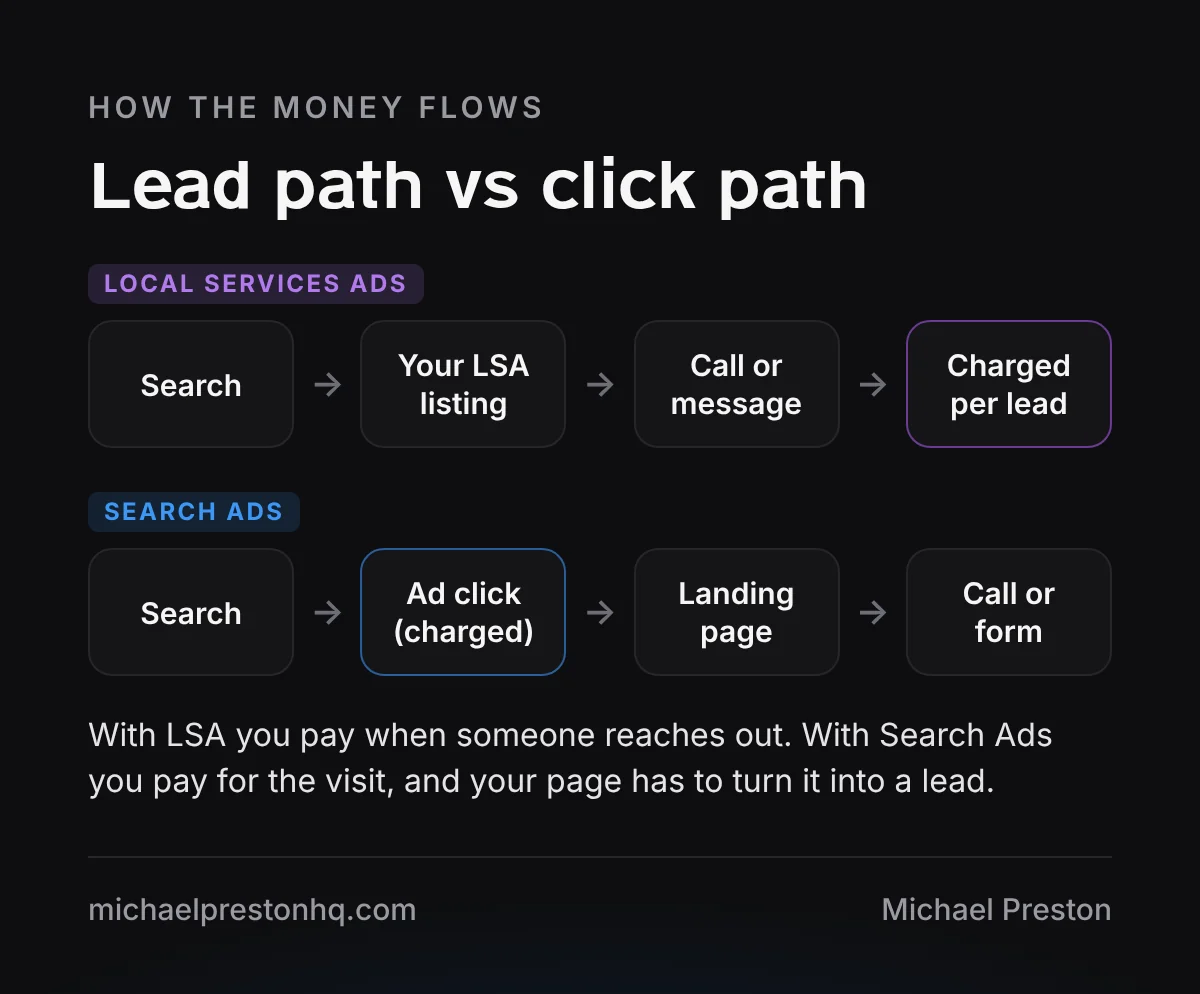
With Search Ads you pay when someone clicks your ad, even if they never call. Your landing page has to turn that click into a lead. With LSA you pay when someone contacts you through the ad.
That sounds like LSA is always better. It is not that simple. Some LSA leads are for jobs you do not do or areas you do not serve, and you still need to answer every one. Search Ads clicks cost money, but a good page and good keywords can turn them into strong leads.
Control over keywords and landing pages
Search Ads give you a lot of control. You choose keywords, write the ads, pick the landing page, set bids and add negative keywords to block searches you do not want.
LSA gives you much less. You pick job types, service area, hours and a weekly budget. Google decides which searches you show for. There is no landing page, because people contact you from the listing.
Reviews and screening requirements
LSA leans heavily on trust signals. The badge and your reviews are front and center. A business with few reviews may struggle to show often, even if everything else is set up right.
Search Ads have no screening step beyond standard ad policies. You can launch faster, but you have to earn trust on your landing page instead.
Comparison table
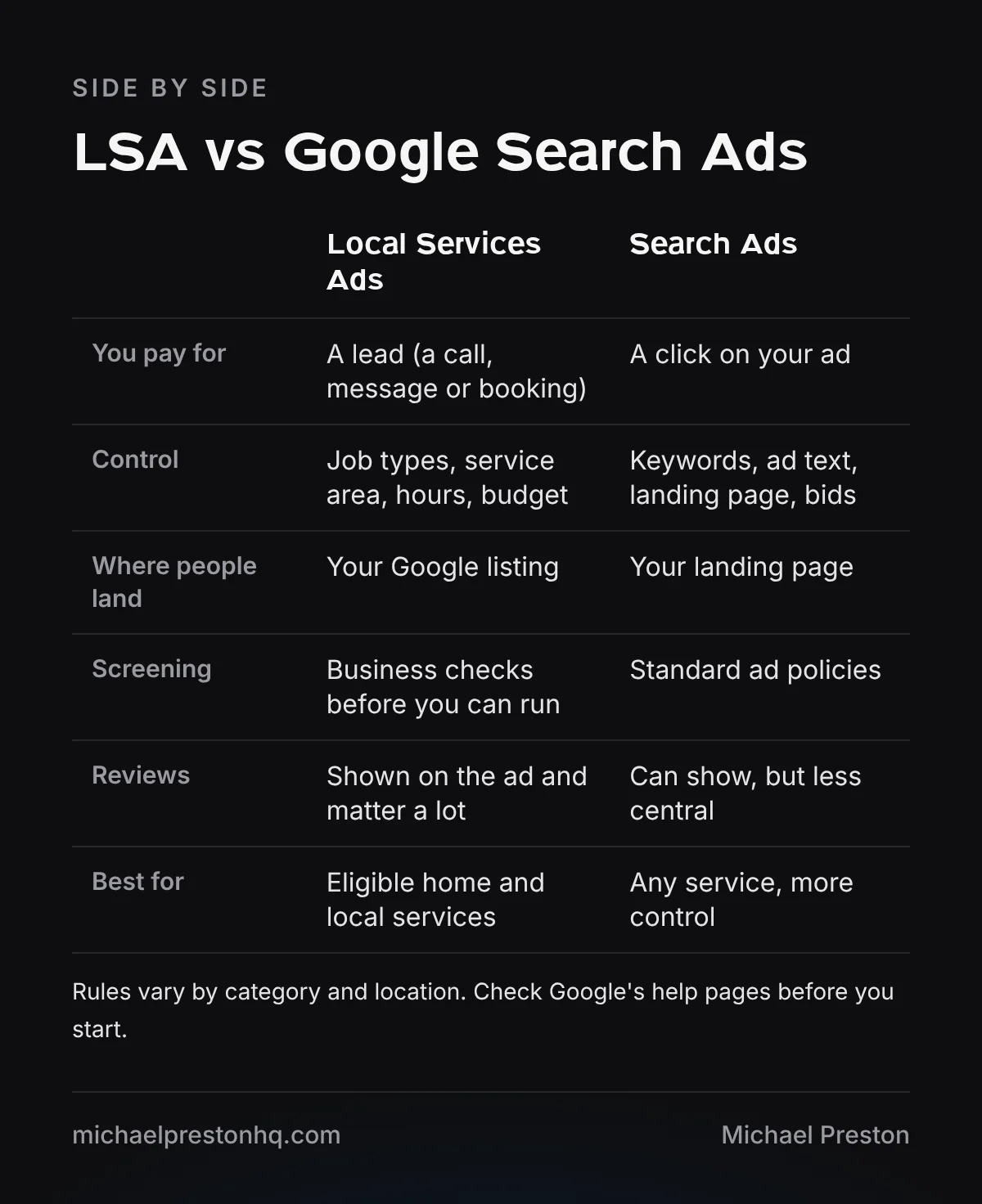
| Local Services Ads | Google Search Ads | |
|---|---|---|
| You pay for | A lead: a call, message or booking | A click on your ad |
| Control | Job types, service area, hours, budget | Keywords, ads, landing page, bids, negatives |
| Where people land | Your Google listing | Your landing page |
| Screening | Business checks before you can run | Standard ad policies |
| Reviews | Shown on the ad and affect how often you show | Can show, but less central |
| Setup effort | Verification can take time | Faster to launch, more to manage |
Which businesses do better with each
LSA tends to fit businesses that are in an eligible category, have solid reviews and answer the phone fast. Home services are the classic case: plumbing, HVAC, electrical, garage doors, pest control and similar.
Search Ads fit businesses that need more control. That includes services LSA does not cover, high value jobs where you want a specific landing page, and businesses that want to target only certain services or towns. If you are new to Search Ads, start with the Google Ads setup guide.
Harborline Plumbing Co. (a made-up business) has strong reviews and answers calls all day. LSA could bring steady repair calls. For water heater replacements, a bigger job, it could run a Search campaign with its own landing page so it controls the message.
Questions to ask before you choose
Answer these honestly before you put money into either one. They will usually point you in the right direction.
- Is my category eligible for Local Services Ads in my area?
- Can I pass the screening for my category, such as license and insurance checks?
- Do I have enough recent reviews to compete on a listing?
- Can someone answer calls and messages quickly during business hours?
- Do I want to control the message with my own landing page?
- Are there specific services or towns I want to focus on?
- Can I track which leads turn into booked jobs?
If most of your answers point to trust, reviews and fast phone handling, LSA is a good fit. If they point to control, specific services and your own page, start with Search Ads. If the answers are mixed, that is a sign you may end up running both.
Whichever you choose, start small and give it enough time to collect real leads before you judge it. One busy week or one slow week tells you very little.
Running both without overlap
LSA and Search Ads show in different places, so running both can make sense. The goal is to avoid paying twice for the same kind of lead without knowing it.
- Split by service. Let LSA cover your core repair calls. Use Search Ads for services or jobs LSA does not cover well.
- Track each one separately. Use different tracked numbers on your landing pages so you can see which leads came from Search.
- Compare booked jobs, not leads. A cheaper lead that never books is not a better lead.
- Review LSA leads weekly. Mark which ones booked, and dispute the ones that qualify under Google's rules.
If you are still deciding between Google and social ads in general, read Google Ads vs Facebook Ads first.
Give each one its own line in your weekly report. Leads, booked jobs and what each one cost you to get. After a couple of months you will know which one deserves more budget.
Why phone handling matters more than the ad
With both LSA and Search Ads, most leads for local service businesses arrive as phone calls. The ad gets the phone to ring. What happens next decides whether you get the job.
Missed calls are the most common leak. If nobody picks up, many people simply call the next business on the list. Set up a plan for busy times: a person who covers the phone, a call forwarding rule, or a quick text back when a call is missed.
Listen to a few recorded calls each week if your tracking allows it. You will hear what customers ask, where your team gets stuck, and which questions should be answered on your landing page or in your listing. Small fixes here often help more than changes to the ads themselves.
Common mistakes with either one
- Turning on LSA and then missing calls. Missed calls hurt you in LSA.
- Sending Search Ads traffic to the home page instead of a page for that service.
- Not tracking which leads became booked jobs, so you cannot tell which ad type works.
- Setting a service area much bigger than where you want to work.
This comparison is part of my paid ads and funnels talk. If you want help deciding for your business, contact me.